



Blog · Industrial Automation · Operations Management
MES vs. SCADA: Start With the Problem, Not the Platform
What each system does, where it fits in the ISA-95 model and which one your plant should build first, explained for operations leaders.
Quick answer
SCADA monitors and controls equipment in real time. It reads PLCs, provides real-time visibility into line performance and raises alarms within seconds. An MES manages production itself. It releases work orders, enforces procedures, records genealogy and quality data and reports performance by shift. SCADA keeps the process running. MES directs and records what gets made.
Key takeaways
- If your pain is visibility into equipment, alarms or remote sites, start with SCADA.
- If your pain is paper travelers, traceability gaps, slow batch release or disputed OEE numbers, you need an MES.
- An MES normally runs on top of SCADA, so the practical question is usually which one to build first.
Plant teams often ask to implement an MES when the real gap is that no one can see what the equipment is doing. Others buy a better HMI when the real problem is that production records live on clipboards. Both systems collect data from the plant floor, so the confusion is understandable. However, they have different uses and a project scoped around the wrong one tends to fail to meet expectations after go-live.
This guide explains what each system does, where each fits within the ISA-95 model and how to determine which system can best solve your problem.
What is SCADA?
SCADA stands for supervisory control and data acquisition. It connects to PLCs, drives and instruments, collects their values and presents them to operators on HMI screens. Operators use it to start and stop equipment, change setpoints and respond to alarms. SCADA platforms commonly log values to a historian so engineers can analyze them later.
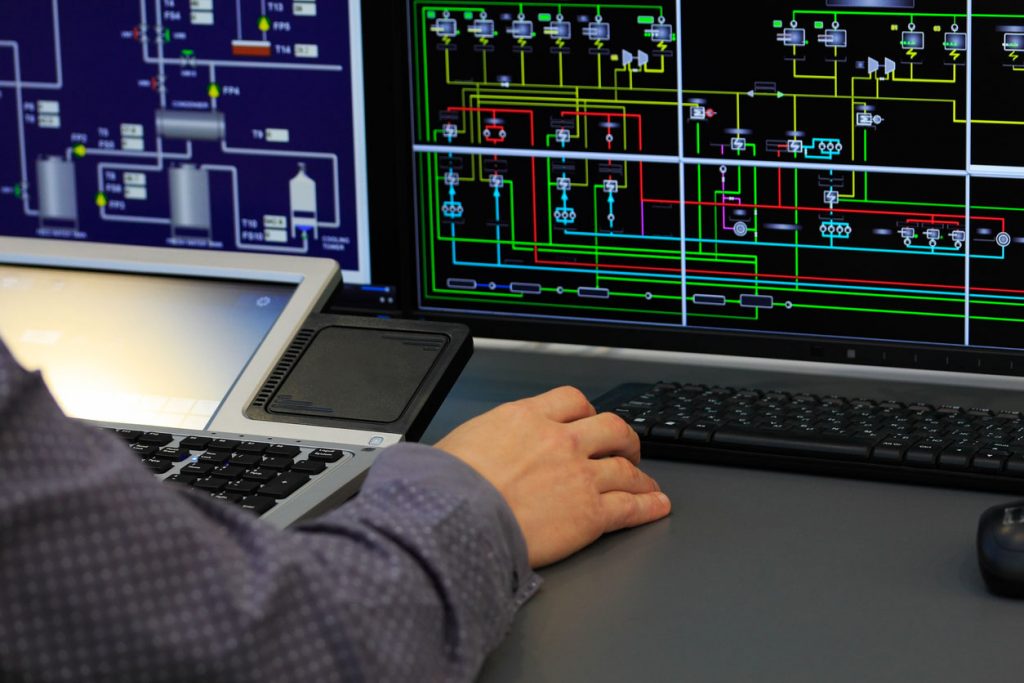
The term started in utilities and water, where a central control room supervises equipment spread across many sites. In discrete and process manufacturing, people use “SCADA” more loosely for the supervisory layer that sits on top of the control system inside a plant. Either way, its job is the same: give people a live, accurate picture of equipment and let them act on it.
SCADA is built to show things like these:
- Whether Line 3 is running right now, and the reason if it is down
- The tank that is approaching its high-level alarm
- The temperature profile on an oven over the last eight hours
Flexware Innovation’s HMI/SCADA services cover this layer, from screen design to alarm management.
What is an MES?
An MES guides and records production work, often on tablets or terminals at the line. It takes orders from ERP, turns them into scheduled production, guides operators through the steps and records what actually happened: which materials went in, who performed each step, what the quality checks returned and how long it all took. For a deeper look at MES on its own, see our overview of what an MES is and the benefits it brings.

Typical MES functions include:
- Work order dispatch and production scheduling at the line level
- Electronic work instructions and electronic batch records
- Material tracking, lot genealogy and traceability
- In-process quality checks and nonconformance handling
- Labor tracking and production performance reporting, including OEE
An MES answers a different set of questions. It can show which raw material lots went into a finished lot, confirm that a batch followed the approved recipe and record who signed each step. It can also compare what the night shift produced against plan and show where the lost time went.
An MES also sits in the middle of the plant’s systems. It takes orders from ERP above it, pulls equipment data from SCADA and historians below it, and exchanges data with the production systems alongside it: LIMS for lab results, recipe management, quality systems, logistics and warehouse systems and, increasingly, a unified namespace (UNS) that publishes plant data to everything else.
See Flexware Innovation’s manufacturing execution systems experience to learn how this layer is scoped and delivered.
What is the difference between MES and SCADA?
The simplest way to separate them is by what each system treats as the unit of work. SCADA thinks in tags, equipment states and alarms. MES thinks in orders, materials, people and products.
| SCADA | MES | |
|---|---|---|
| Primary job | Monitor and control equipment | Manage and record production |
| ISA-95 level | Level 2, supervisory control | Level 3, manufacturing operations management |
| Time frame | Subseconds to hours | Seconds to days, organized by shift, batch and order |
| Main users | Operators, controls engineers, maintenance | Production supervisors, quality, planners, plant management |
| Core data | Tag values, equipment states, alarms, events | Work orders, materials, lots, personnel, quality results |
| Typical outputs | HMI screens, alarm logs, historian trends | Batch records, genealogy, production and OEE reports |
| Connects mainly to | PLCs, drives, instruments | ERP, SCADA, historians and production systems such as LIMS and quality |
Not sure which layer your problem lives in?
Flexware Innovation works across ERP, MES and SCADA, so the conversation starts with the decision you need to support.
Where do MES and SCADA sit in the ISA-95 model?
ISA-95 (also published as IEC 62264) is the international standard for integrating enterprise and control systems in manufacturing. Its functional hierarchy runs in levels, and our guide to ISA-95 in practice covers the full model:
- Level 4Business planning and logistics. ERP: orders, inventory, purchasing and finance.
- Level 3Manufacturing operations management. MES lives here, with quality and maintenance operations.
- Level 2Monitoring and supervisory control. SCADA, HMIs and distributed control systems live here.
- Level 1Sensing and manipulation. Sensors, actuators and the PLCs that drive them.
- Level 0The physical process. The machines and materials themselves.
The levels also differ in pace. ISA-95 describes Level 2 activity in hours, minutes, seconds and fractions of a second, and Level 3 activity in days, shifts, hours, minutes and seconds. That difference in clock speed is a practical test. If the decision you need to support happens in seconds at the machine, it belongs at Level 2. If it happens across a shift or a batch, it belongs at Level 3.
The handoffs between levels are where many projects get hard. ERP orders need to reach the floor in a form operators can execute, and machine data needs context (which order, which lot, which product) before the business can trust it. Flexware Innovation’s industrial data management and ERP integration work focuses on those connections.
Do you need MES, SCADA or both?
Start with the symptom, then work back to the layer.
Symptoms that point to SCADA:
- Operators walk the floor to check equipment status.
- Alarms are missed, or there are so many that people ignore them.
- Remote sites are checked by phone call or a site visit.
- Engineers cannot pull a trend for a process variable after an incident.
Symptoms that point to MES:
- Production records live on paper travelers or spreadsheets that are typed in later.
- A quality hold takes days to scope because no one can quickly trace which lots are affected.
- Batch record review delays product release.
- Each department reports a different OEE number for the same line.
- Planners cannot see actual progress against the schedule until the shift ends.
“Flexware Innovation helped educate us on the benefits of MES. … We are now partnering with Flexware for future phases of our MES design and rollouts.”
Consumer Packaged Goods Manufacturer, Flexware Innovation client
Many plants recognize items from both lists. In that case the usual answer is both systems, built in the right order. An MES depends on reliable equipment data, so a plant with weak connectivity at Level 2 often needs to fix that first. A plant that already has good SCADA and historian coverage can often move straight to MES functions that use the data it is already collecting.
Can a SCADA system do MES functions?
Several modern SCADA platforms offer modules for OEE, downtime tracking, simple work order tracking or recipe management. For a single line with straightforward reporting needs, that can be enough.
The limits show up when you need full genealogy across many lines, enforced procedures with electronic signatures, integration with ERP orders and inventory, or records that will stand up to an audit. Those are core MES responsibilities, and stretching a supervisory platform to cover them usually means custom development that someone has to maintain. Start from the functions your operation needs to run, record and prove, then choose the platform that covers them.
What changes in regulated manufacturing?
In pharmaceutical, biotech and medical device manufacturing, the line between MES and SCADA carries extra weight. Under FDA 21 CFR Part 11, electronic records and electronic signatures must be trustworthy and reliable. That brings requirements such as secure audit trails, controlled access, validated systems and signatures that are clearly linked to the record they approve.
Electronic batch records, the GMP record of how each batch was made, are usually an MES function. SCADA and historian data often feed those records, so the supervisory layer still matters for compliance, but the MES is typically where the regulated record is created, reviewed and approved. Teams planning either system in a regulated plant should scope validation from the start. Flexware Innovation’s Life Sciences team works on these requirements.
Planning an MES or SCADA rollout?
Get the sequence right before the first line goes live.
How should you sequence an MES or SCADA project?
- Name the decision you are trying to improve. Write down who makes it, how often and what information they lack today.
- Map that decision to an ISA-95 level. Seconds at the machine point to Level 2. Shifts, batches and orders point to Level 3.
- Audit the data you already have. Check PLC connectivity, historian coverage and the quality of existing tags before designing anything above them.
- Define the integration points. Decide how orders arrive from ERP and how results go back, and which system owns each piece of data.
- Pilot on one line or area. Prove the workflow with real operators before scaling to the rest of the plant.
- Plan for operation after go-live. Assign ownership for support, updates and, in regulated plants, change control.
For organizations still deciding where to start, Flexware Innovation’s Smart Manufacturing advisory work helps connect the roadmap to the realities of existing equipment and capital plans.
Frequently asked questions
Is SCADA part of an MES?
No. SCADA is a separate layer at ISA-95 Level 2 that monitors and controls equipment. An MES at Level 3 usually consumes data from SCADA and historians, then adds production context such as orders, materials and quality results.
Does an MES replace ERP?
No. ERP plans the business at Level 4: orders, inventory, purchasing and finance. An MES executes and records production on the floor at Level 3 and reports results back to ERP.
What is MOM, and how is it different from MES?
MOM, or manufacturing operations management, is the ISA-95 term for all Level 3 activity: production, quality, maintenance and inventory operations. MES usually refers to the production portion of MOM, and in practice the two terms are often used interchangeably.
Which should we implement first, MES or SCADA?
It depends on your data foundation. If equipment data is unreliable or unavailable, SCADA and connectivity usually come first because an MES depends on them. If supervisory data is already in good shape, MES can often start on top of it.
Can one platform provide both MES and SCADA?
Yes. A single platform can provide supervisory and MES modules on a shared foundation. Whether that fits depends on the functions you need, your regulatory requirements and the systems already in place.
Talk with a Flexware Innovation engineer about your plant
Tell us what you are seeing on the floor. An engineer who works across ERP, MES and SCADA will follow up to talk through where the problem sits and what to build first.
Prefer to talk now? Call (317) 813-5400


